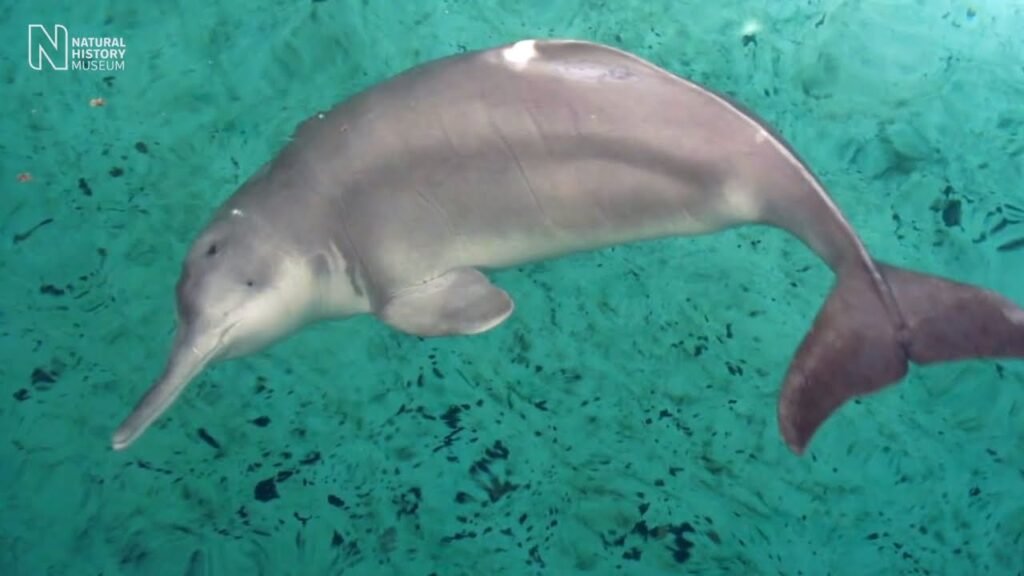
QiQi, a baiji river dolphin that died in 2002, was probably one of the last of his species. © Institute of Hydrobiology, Chinese Academy of Sciences.
Have you ever seen a Baiji, a river dolphin?
If yes, you are very lucky. If not, please have a look and let’s meet the smiling Baiji.
Most people believe that dolphins live in the sea, not in rivers. But there are some special rivers around the world that are home to certain dolphin species.
It is estimated that there were 5,000 Baiji when they were described in the ancient dictionary Erya, circa the 3rd century BC. A traditional Chinese story describes the Baiji as the reincarnation of a princess who was drowned by her family after refusing to marry a man she did not love. Regarded as a symbol of peace and prosperity, the dolphin was nicknamed the “Goddess of the Yangtze.”
Unfortunately, as pollution continues to destroy peace and prosperity around the world, it also killed the “Goddess of the Yangtze.” The disappearance of the Baiji Chinese river dolphin is the first extinction of a major mammal since the demise of the Caribbean monk seal and the Japanese sea lion in the 1950s.
Wuhan, 13 December 2006, The Baiji Yangtze dolphin is, with all probability, extinct. In the city of Wuhan in central China, a search expedition under the direction of the Institute of Hydrobiology, Wuhan, and the Swiss-based baiji.org Foundation concluded without any confirmed sightings.
Lead was listed in 1976 as an air pollutant. Concentrations of lead in the air have caused many problems. Battery makers, lead smelters, and refiners have lobbied the administration to remove Clean Air Act limits. But the Baiji has gone the way of the dodo… (The dodo became extinct in the 17th century.)
Humans exceed limits, species decrease.
Pollution increases, species decrease.
Now here’s a look at the history of the Baiji Chinese river dolphin.
Timeline
circa 3rd century BC: population estimated at 5,000 animals
1950s: population estimated at 6,000 animals
1958–1962: The Great Leap Forward denounces the animal’s traditional venerated status
1970: The Gezhouba Project begins
1979: The People’s Republic of China declares the Chinese river dolphin endangered
1983: National law declares hunting the Chinese river dolphin illegal
1984: The plight of the Baiji draws headlines in China
1986: population estimated at 300
1989: Gezhouba Dam completed
1990: population estimated at 200
1994: Construction of the Three Gorges Dam begins
1996: IUCN lists the species as critically endangered
1997: population estimated at fewer than 50 (23 found in survey); a dead Baiji was found with 103 separate open wounds
1998: 7 found in survey
2003: Three Gorges Dam begins filling reservoir
2004: last known sighting
2006: none found in survey; declared “extinct”
2007: results of survey published in the journal Biology Letters
Causes of Decline
The World Conservation Union (IUCN) has noted the following threats to the species: hunting during the Great Leap Forward, entanglement in fishing gear, the illegal practice of electric fishing, collisions with boats and ships, habitat loss, and pollution. During the Great Leap Forward, when traditional veneration of the Baiji was denounced, it was hunted for its flesh and skin and quickly became scarce.
As China developed economically, pressure on the river dolphin grew significantly. Industrial and residential waste flowed into the Yangtze. The riverbed was dredged and reinforced with concrete in many locations. Ship traffic multiplied, boats grew in size, and fishermen employed wider and more lethal nets. Noise pollution caused the nearly blind animal to collide with propellers. Stocks of the dolphin’s prey declined drastically in recent decades, with some fish populations falling to one thousandth of their pre-industrial levels.
In the 1970s and 1980s, an estimated half of Baiji deaths were attributed to entanglement in fishing gear. By the early 2000s, electric fishing was considered “the most important and immediate direct threat to the Baiji’s survival.” Though outlawed, this fishing technique is widely practiced throughout China. The building of the Three Gorges Dam further reduced the dolphin’s habitat and increased ship traffic.
For those who love films, especially Hayao Miyazaki and animation, please watch Spirited Away (and if you have already watched it, perhaps watch it again) and meet Haku with all this information in mind. Then you will know there is a reality behind this fiction. Do you remember Haku’s real name, Nigihayami Kohakunushi (White River Dragon Boy)? And why he forgot it?
A spirit disappears in Kohaku. A goddess disappears in the Yangtze. As people of this planet, it is our responsibility to protect this planet and let life cherish and flourish in harmony.
It has been years since the Baiji was declared “extinct.”
https://www.nhm.ac.uk/discover/baiji-why-this-extinct-river-dolphin-still-matters.html
Please watch the video below for more: